BB's Album Rankings - Jethro Tull
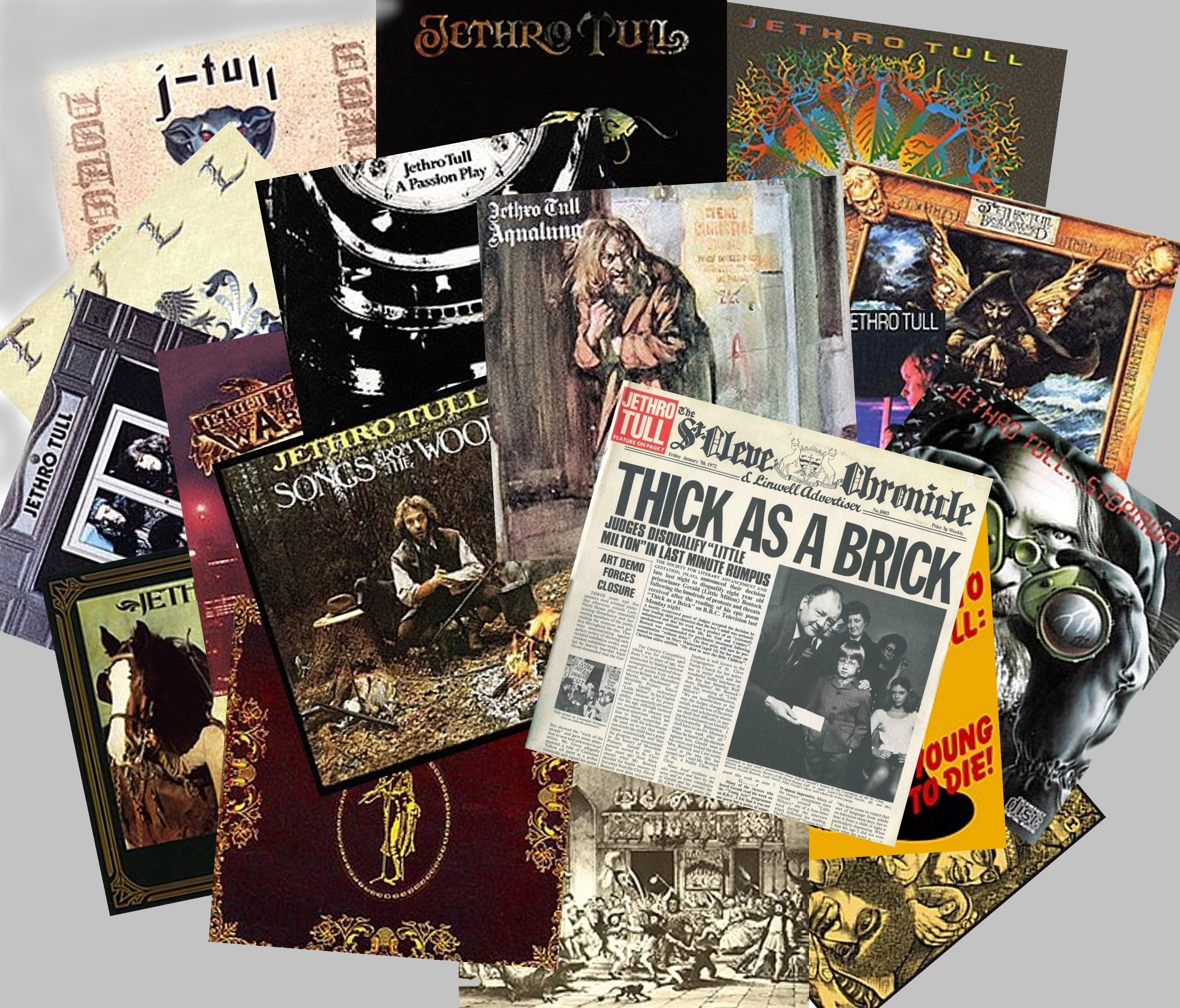
Time for another album rankings session, and this is a big one. This time I'm featuring one of the all-time great classic and progressive rock bands, Jethro Tull. Jethro Tull had its start way back in 1967, and of course has been led from the beginning by the dynamic composer-flautist-guitarist-vocalist Ian Anderson. They started as a mostly blues-oriented rock band, as was very popular in the UK at that time. Their first album, This Was (1968) featured blues gutarist Mick Abraham, but Mick departed after just one album, and was replaced by guitarist extraordnaire Martin Barre, who has been a fixture with the band for most of its long history. The second album, Stand Up (1969), introduced more progressive elements, as well as a more folk-inspired sound and approach, whereas Benefit (1970) returned to a more standard blues-oriented style. But their big breakthrough album was Aqualung (1971), which combined a ferocious hard rock style with more melodic and folky acoustic elements to create a rock masterpiece. They followed that success with a string of classic progressive rock albums, most notably Thick as a Brick (1972), all retaining that mix of biting rock and melodic folk elements. All through their hey-day in the 1970's, they had a pretty stable lineup that, in addition to Anderson, featured Martin Barre's guitar versatility, the fantastic Barriemore Barlow on drums and percussion, John Evan on keyboards, and Jeffrey Hammond on bass. This lineup excelled and weaved intricate ensemble works with one fantastic album after another. But by the 1980's, as the popularity of progressive rock waned and the band struggled to remain successful, the band (with many lineup changes) tried some different styles with varying success. By the 2000's the band seemed about done and Anderson moved on to primarily doing solo albums. But recently (2022), Ian Anderson released a new album (The Zealot Gene) under the Jethro Tull name. Known for their intricate compositions and virtuoso musicianship, as well as as Ian Anderson's antics and their fantastic concert performances, Jethro Tull has been a consistently great and unique rock band. So, over a period of 54 years (!), Jethro Tull has released a total of 23 studio albums, which includes Living in the Past (1972), which is generally considered a compilation album, but since it consists mainly of early singles, EPs, B-sides, and unreleased material that were not included on any album (and were not previously released in the US), I still consider this as a relevant studio album. It also includes the Christmas Album (2003) which was mainly a compilation of re-workings of previously released holiday-themed songs with some traditional seasonal songs, so I am not including this in my rankings. However, I am also including Thick as a Brick 2 (2012), which was released as an Ian Anderson solo album, but since it was billed as a direct sequel of the classic Tull album, I am also including that here in the rankings. Thus, there are 23 albums I am including in these rankings. Overall, they have one of the most impressive catalogs in all of rock history. In going through the albums, I was very familiar with all of the 1970's output, but I had not really listened to most of the albums after that time, so many were new to me. I was prepared to slog through at least some quite bad albums, but happily, just about all of their albums are at least good, if not great or spectacular. I only found one album in their entire output that I would call 'bad', and that was a 1-album anomaly, as well as 1 album that was just OK. All the rest had at least some quite good songs and an overall good ranking, even if not among their best work. Thus, a whopping 21 out of their 23 albums I rated as good or better, with the nearly all of their top ten I consider as great albums, overall an incredible output of quality over the years. As always, this list is just my own personal opinion regarding these albums and does not represent any other assessments or rankings. You will have your own opinion on this, and I welcome any comments or your own version of these rankings.
#23. Under Wraps (1984)

This is the only Tull album that I would consider to be genuinely bad. This is mainly due to the horrendous production and arrangements. Ian made a terrible decision to use programmed drum machines throughout (no drummer at all), presumably to seem hip and modern, then compounded that error by featuring that awful drum machine prominently above everything else in the mix. Also used programmed synths and cut and paste arrangements throughout that just sound terrible. Should have been considered an Anderson solo album, as sounds like Ian just playing with his new electronic toys and digital software. The music was assembled, not really played here, and the '80's technology used just doesn't cut it. It's too bad, as some of the songs could have been pretty good with the programmed nonsense removed and real instruments and arrangements used, as exemplified with the two different versions of the song 'Under Wraps', one with all the electronic nonsense, the other stripped down. The production and arrangements here deserve only 1 star, but the songs themselves deserve higher, so I arrive at 1.5 for the album. No really good tracks (but the one song with a stripped down version, Under Wraps #2, gives an idea of what the album could have been like with decent production).
Rating: 1.5ó#22. Rock Island (1989)
Probably their heaviest album overall, with more rock-heavy and harder rock songs, with very little acoustic work. This may have been in response to the backlash they received after winning the Grammy Award for best hard rock/heavy metal album in the previous year for an album (Crest of a Knave) that was considered neither hard rock nor metal. So they came back with a more rock-heavy album To solidify their hard rock credentials. Unfortunately, the result is one of their least enjoyable albums, without much to recommend it. I really could not pick out the best and worst songs here, as all are just OK. Nothing really bad, but also just not that good either. Contains many familiar elements of Tull songs, but the songs just don't gel into anything substantial. Somewhat generic songs, mostly not very memorable.
Rating: 2.5ó#21. J-Tull Dot Com (1999)
Ian and the band trying many different things here, so there is a variety of styles, which is interesting, but also what seem like some odd choices for the band. Not at all bad, there are several good tracks here, and some are quite fun, including a strong finish to the album, but also some questionable tracks. Runs the gamut from harder rock songs like Spiral to a lightweight acoustic carribean-themed ditty (Hot Mango Flush) that is unlike any other Tull song. Thus, overall, a pretty good, but somewhat uneven album. Does contain quite a lot of great guitar and flute work throughout.
Best tracks: Dot Com, Hunt By Numbers, Far Alaska, The Dog Ear Years, A Gift of Roses.
Weaker tracks: El Nino, Black Mamba.
Rating: 3ó#20. The Zealot Gene (2022)
Ian Anderson is back with a new incarnation of Jethro Tull, and the first new Tull album in nearly 20 years. And Ian harkens back to sounds and styles reminiscent of some of their earlier albums. Overall, it’s great to hear Ian’s flute as a major component as well as some of Tull’s characteristic styles and strong songwriting throughout. However, Ian’s voice is certainly not what it used to be, but his talk-singing style works well enough here. Where the album falls flat, unfortunately, is with the backing band, which is just completely generic, lackluster, and unproductive. The album does seem to really be an Ian Anderson solo album, as the backing musicians contribute little here, and weaken what could have been several very strong tracks. Certainly not like Jethro Tull of the glory days, where stellar guitar work from Martin Barre and the dynamic drumming of Barriemore Barlow provided scintillating contributions to the Tull sound. Here, the musicians other than Anderson just don’t provide much spark at all. Because of this, the more acoustic tracks work best here, and there are still several very nice songs, making this enjoyable, but somewhat frustrating.
Best tracks: Mrs. Tibbets, Sad City Sisters, Three Love Three, In Brief Visitation, Betrayal of Joshua Kynde.
Weaker track: The Zealot Gene.
Rating: 3ó.#19. Crest of a Knave (1987)Somewhat of a comeback album for the band, following the dismal
Under Wraps. Brought back a harder rock edge on a few tracks, and received substantial radio play and acclaim. Notoriuosly won the Grammy for best hard rock/heavy metal album (beating Metallica), which was roundly criticized as it is not really considered a hard rock album, and certainly not metal. Overall, it is somewhat varied in style and substance, ranging from acoustic, pop and rock tracks. This album also marked the start of their 'Dire Straits period', in that multiple songs on this album, and at least one on most of the subsequent albums, bore a strong resemblance to Dire Straits, not only in the talk-singing vocal of Ian by this time, but also in the overall style and structure of the songs. Not sure if this was a conscious decision to emulate the band, but some of these songs sound like they could actually be Dire Straits songs (not that there's anything wrong with that). Overall, a nice direction for the band in the 80's. Good, but still not one of their stronger albums.
Best tracks: Jump Start, Budapest, Part of the Machine, Farm on the Freeway.
Weaker tracks: Steel Monkey, Mountain Men.
Dire Straits-sounding songs: She Said She Was a Dancer, Waking Edge, Raising Steam.
Rating: 3ó#18. Thick As A Brick 2 (2012)
Released as an Ian Anderson album (actually listed as
Jethro Tull's Ian Anderson), but claiming to be a sequel to Tull's acclaimed 1972 masterpiece
Thick as a Brick. This album continued on from TAAB by following (or speculating) on what had happened in the intervening years to Gerald Bostock, the fictional central figure responsible for the original Thick as a Brick Poem. Thus, in various sections of the full piece Gerald is imagined as a banker, a homeless person, etc. Although Ian tries to incorporate token themes from TAAB at various points in the narrative, overall, there is little here musically or thematically that is very connected to the classic album. The songs here are fine, but only a few are very memorable, and certainly do not reach the heights of innovation and creativity achieved on the classic. It's nice to hear some of the shout-outs to the original, but those are the main highlights here.
Best tracks: A Change of Horses, What-Ifs Maybes and Might-Have-Beens, Old School Song, Banker Bets Banker Wins.
Weaker tracks:Cosy Corner, A Pebble Thrown.
Rating: 3ó#17. Catfish Rising (1991)Starts off with a couple somewhat generic rockers, but then gets much more interesting. More acoustic than expected (lots of mandolin), and more diverse. Very Bluesy, from bluesy acoustic numbers to slow blues to blues-rock. Probably their most blues-heavy album since
Benefit, and overall, it works very well, as they change-up the various blues styles throughout the album.
Best tracks: Roll Your Own, Rocks on the Road, Gold-Tipped Boots Black Jacket and Tie, When Jesus Came to Play.
Weaker tracks: This is Not Love, Occasional Demons, White Innocence.
Rating 3ó#16. Roots to Branches (1995) This one starts off with a more International-World music style, with the first few tracks having a somewaht middle eastern vibe. Rest of album features many strong tracks that make this one of their best from the later years, with a variety of styles, strong songwriting, and excellent musicianship throughout. Also includes another in their Dire Straits-like series from this period: Another Harry's Bar.
Best tracks: Valley, Beside Myself, Dangerous Veils, At last Forever, Out of the Noise, Stuck in the August Rain.
Weaker tracks: Rare and Precious Chain, This Free Will.
Rating: 3ó#15. This Was (1968)
Strong debut album. At this early stage the band had a very different lineup, with blues guitarist Mick Abrahams, Glenn Cornick (bass), and Clive Bunker (drums), and was primarily a straight blues-rock band, with jazz influences. The album is filled with excellent jazz-blues guitar, bass, and drums work, supplemented with Anderson's flute and vocals, but good UK blues-rock bands were plentiful at that time, and this is fairly straight-forward blues-rock. Although a good start, the band had not yet developed their own unique style, and compared to what the band would later become, this ranks as good, but not great.
Best tracks: Beggar's Farm, A Song For Jeffrey.
Weaker tracks: Moved On Alone, It's Breaking Me Up.
Rating: 3ó#14. Benefit (1970)I know a lot of people love this album, but for me, it is somewhat of a step backward from the more unique and progressive
Stand Up (1969), as the band has fallen back to a much more standard UK Blues-rock here, without the more innovative approaches and advances made on the previous album. Yes, they are very good at the blues-rock sound and style, but this does not best show their unique style and strengths that would make them a standout rock band. Also, some of the best songs from these sessions were not even included on the album, such as 'Teacher' (which was released as a standalone single) and 'Witch's Promise'. Thus, a very good album overall, but one that did not advance their sound and unique style beyond the blues-rock played by other bands. However, they would make tremendous leap into progressive rock with their next album.
Best tracks: Nothing to Say, Alive and Well and Living In, Inside, Sossity You're a Woman.
Weaker tracks: Son, A Time For Everything.
Rating: 3.5ó#13. Broadsword and The Beast (1982)More personnel changes, with Peter John-Vettese brought in on keyboards and synths and Gerry Conway on drums, along with Dave Pegg on bass. The band returns to more folk-style songs and themes here, and acoustic instrumentation, but now also incorporating more synths and electronics as well. Thus, more synths and less acoustic guitar, but the songs and arrangements are quite good overall, although ends a bit weakly compared to rest of album.
Best tracks: Clasp, Fallen on Hard Times, Flying Colors, Slow Marching Band, Pussy Willow.
Weaker tracks: Seal Driver, Cheerio.
Rating 3.5ó#12. Too Old To Rock n Roll, Too Young To Die (1976) I remember being quite disappointed with this album upon its original release, as it seemed quite a step down from the thrills and invigorating highs of their previous albums. Not really bad, but somewhat lackluster in comparison. However, going back to it many years later I find it to be a very good album (especially compared to some of the later albums) with lots to recommend it. It still has that warm 1970's production, some great songs, and an overall comfortable feeling. The album starts off great, with a wonderful first half, with strong tracks such as Quiz Kids, Crazed Institution, and Salamander, but then sags quite a bit in the second half. Still very good, but overall the weakest of their great 1970's output.
Best tracks: Salamander, Quiz Kids, Crazed Institution, Pied Piper.
Weaker tracks: Bad-eyed and Loveless, The Checquered Flag.
Rating 3.5ó #11. Stormwatch (1979)Often considered to be the third of a trilogy of more folk-oriented albums, but I don't really hear that, as there are only a few songs that follow that example. Overall, the album is less acoustic, and quite a bit darker and heavier than the previous two. I find it to be more closely aligned with albums such as
War Child and
Minstrel in the Gallery, with its darker and heavier aspects. A fine album nonetheless, but the more acoustic songs do work best here.
Best tracks: Flying Dutchmen, Dun Ringill, Warm Sporran, North Sea Oil, Home.
Weaker tracks: Dark Ages, Something's On the Move.
Rating 3.5óTop 10#10. A (1980)Different sound from previous Tull albums. Originally planned to be a solo album from Ian Anderson, thus contained a different lineup of back-up musicians, with only Martin Barre present from the previous band. This gave Anderson a chance to experiment and play around with sounds and styles not previously associated with the band. Thus this album introduces synthesizers and more electronic keyboards throughout. However, the label insisted that the album be released as a Jethro Tull album, which essentially re-booted the band with a new lineup, leaving John Evan and Dee Palmer now out of the band (drummer Barriemore Barlow had already left, and bassist John Glascock died in 1979). The album opens with a few rock songs in fairly typical Tull style, but then changes abruptly to a much more 'progressive' or 'proggy' style for the next several songs (most notably Black Sunday, Protect and Survive, Batteries Not Included, and Uniform). Actually, this is the most 'progressive' sounding Tull album, and it mostly works, as the synths and prog are used well, and provides an interesting new sound for the band. But then near the end of the album, there is a throwback to the more folky acoustic sound with Pine Marten's Jig (perhaps a leftover track from the previous folk-influenced albums?). Overall, a very interesting departure for the band, blending their established unique style with a more electronic and open-ended progressive approach and style, and Anderson makes the most of it.
Best tracks: Black Sunday, Protect and Survive, Batteries Not Included, Uniform, 4 W.D., Pine Marten's Jig.
Weaker track: Working John Working Joe.
Rating 3.5ó #9. Stand Up (1969) Great advancement from their first album, still starting from a blues-based structure, but introducing more progressive elements, varied songwriting, instrumentation, and arrangements, and starting to show those unique Tull qualities that they would further develop on subsequent albums. The beginning of their great ability to go back and forth between acoustic and more rocking songs.
Best tracks: Look Into The Sun, Back to the Family, Reasons For Waiting, We Used to Know, Bouree.
Weak tracks:none.
Rating: 4ó#8. War Child (1974)A divisive album among fans, but I find it mostly excellent. Although the album starts out a bit shaky with the first couple tracks having somewhat odd and less appealing melodies and arrangements, the album takes off from there with the rest of side 1 delivering unique and interesting songs, and then soars with an excellent second half. Anderson uses some of the songs to respond to his critics, but in generally clever ways. The use of additional instrumentation, such as saxophone, accordian, and sitar(?), adds delightful elements to several songs, and the band keeps experimenting and adding additional sounds and textures to their music.
Best tracks: Skating Away, Only Solitaire, Third Hoorah, Two Fingers, Ladies, Back-Door Angels.
Weaker tracks: War Child, Queen and Country.
Rating: 4ó #7. Heavy Horses (1978)A worthy follow-up to
Songs From the Woods, continuing somewhat in the folk-influenced and more acoustic style of that album, but with some twists. Lyrically, Heavy Horses shifts to more earthly and realist themes of country living, thus is a bit more somber in mood. However, the songs are uniformly good to great, again mixing more rock-oriented songs with delicate acoustic tracks and beautiful melodies.
Best tracks: One Brown Mouse, Acres Wild, Moths, Rover, And The Mouse Police Never Sleep.
Weaker track: No Lullaby.
Rating: 4ó#6. Minstrel in the Gallery (1975) Continues with the electrifying mix of eclectic hard rock and acoustic, melodic ditties of their previous albums, with this one tracking a bit darker and heavier with more of a dichotomy between the lighter and heavier sections. Contans a mix of shorter songs alongside the epic-length centerpiece of the album, Baker Street Muse. Also contains some of their best hard-rocking segments alongside beautiful and memorable melodies. A Great album.
Best tracks: Cold Wind in Valhalla, One White Duck/Nothing at All, Baker Street Muse.
Weak tracks: none.
Rating: 4.5ó#5. A Passion Play (1973) This stunning follow-up to their groundbreaking
Thick as a Brick remains a divisive album among fans, many hailing it as a masterpiece while others dismiss it as as a cumbersome and pretentious misstep. Once again, it contains a single album-length song split between the two sides of the album (although subsequent releases have divided the single track into numerous named subtracks). The 2 parts are also separated by the short comedic song The Story of the Hare Who Lost his Spectacles, which has also raised speculation on the value of its inclusion. As a whole composition, APP is also quite brilliant, with many virtuosic sections, but it does not quite reach the heights of
Thick as a Brick. It is quite dense and complicated, more of an acquired taste that requires repeated listens to fully appreciate. It is clear that the band was trying to replicate or even surpass what they achieved with TAAB, and sometimes that is to its detriment, as APP is just not as melodic, engaging, or accessible, but is nonetheless a compelling and rewarding experience, and an incredible album.
Rating: 4.5ó #4. Living in the Past (1972) Although essentially a compilation album featuring non-album singles and B-sides, EPs, and previously unreleased tracks from their earlier days, along with a few selected album and live tracks, released to capitalize on the newfound success of the band (post-Aqualung and TAAB), this album still deserves to be included here due to the abundance of songs that are not included on any other album. And most of the singles, etc. had never been released in the US (only the UK), so it did contain mostly 'new' songs at that time. Not coincidentally, it also contains some of the band's greatest songs ever. In particular, all the songs from the EP
Life's a Long Song (1971) are stellar (Life's a Long Song is one of my all-time favorite songs), and had not been heard in US previously. Those plus the addition of previously unreleased songs from earlier sessions make this an essential part of any Tull collection, and a stellar album.
Best tracks: Life's a Long Song, Wond'ring Again, Living in the Past, Nursie, Witch's Promise, Teacher, Love Story, Just Trying to Be.
Weaker track: Dharma for one (live).
Rating: 4.5ó#3. Songs From the Wood (1977) Superb album. The band leans more into the folkier side of their repertoire here, invoking folk songs and tales, mixed with an effervescent driving rock core producing a remarkable Prog Folk classic. A bright, bold, invigorating breath of fresh air amidst the predominant music of that time. Somewhat of a comeback from the mild disappointment of their previous album. Great songs enhanced by stellar production and arrangements, particularly the drums and percussion of Barriemore Barlow (drums, marimba, xylophone, bells, timpani, etc.) and his drumming as a melodic instrument here. Great contributions from John Evans keyboards and of course, Martin Barre's guitar and Ian Anderson's vocals and flute. Some of their most delightful and energetic songs ever.
Best tracks: The Whistler, Velvet Green, Songs From the Wood, Jack-in the Green, Fire at Midnight.
Weak tracks: none.
Rating: 5ó#2. Aqualung (1971)A stunning rock masterpiece. Expertly blends driving hard rock riffs with gentle acoustic and melodic sequences, mixing in folk, rock, pop in what would become a very influential and much-copied style, yet never quite achieved so masterfully. Although often considered a concept album dealing with the distinction between religion and God, and Anderson's dour musings on faith and religion, the band disputes this, as only a few songs have any unifying theme relating to religion. Several of the songs also deal with the plight of outcasts and the downtrodden. The religion-themed songs, such as My God, Hymn 43, and Wind-Up are undeniably compelling and powerful, but so is the entire album from beginning to end. The composition and inclusion of the acoustic numbers (Cheap Day Return, Mother Goose, Wond'ring Aloud, and Slipstream) is just magnificent and provide a perfect balance to the album. A tremendous leap from previous album
Benefit, and the start of super-stardom for the band.
Best tracks: Mother Goose, Wond'ring Aloud, Wind-up, Locomotive Breath, Aqualung, Hymn 43, Cross-Eyed Mary, Slipstream, My God.
Weak tracks: none.
Rating: 5ó#1. Thick As A Brick (1972) As great as
Aqualung is, it cannot match the sheer brilliance and gloriousness of
Thick as a Brick, the pinnacle of their three masterpiece albums, and one of the best-ever progressive rock albums. Although constructed to be a parody of the concept album approach (in response to critics referring to
Aqualung as a concept album when Anderson maintained it was not), this album-length single composition (split into 2 album sides) consisting of many separate parts brought together with ingenious transitions and connecting sections. Intricately crafted songs and parts that fit together magnificently, and mixing the acoustic melodies with the harder rock elements as only prime Tull can, and while still also managing to be quite accessible, featuring some of Tull's most melodic and joyous passages. Even though the whole piece runs for ~44 minutes (with only a brief break between sides), there is not a single dull or lackluster moment anywhere, nor any part or section that doesn't fit or should have been left off. Just brilliant from start to finish. Also, the most cohesive and locked-in the whole band is here, with each member contributing greatly to the whole, particularly Barriemore Barlow's dynamic drumming and inspired percussion work that stands out, as well as Martin Barre's guitar work, and of course Anderson's flute and probably his best-ever vocal performance. And it still stands now, fifty years later, as time has not diminished the power and magnificence of this album in the slightest. it stands as a monumental achievement in rock music.
Rating 5ó BB’s Rating scale:1ó – Terrible, torturous to have to listen to
1.5ó - Poor, not worth your time
2 ó – Fair, maybe a couple half-way decent songs, but
sub-par overall
2.5ó – Average, OK, meh, not bad but not that good either
3ó – Good, solid album, several good songs, but not
spectacular. Certainly worthy, but may not be something you come back to very
often
3.5ó – Very good album. Some stellar tracks, very
enjoyable overall
4ó – Great album, filled with great songs, one that you
will want to come back to over and over again
4.5ó – Excellent album, beyond great, superb in every
way, just short of a masterpiece
5ó – A Masterpiece, among the greatest albums of its
type, and has stood the test of time
OK, well that's what I think of the Jethro Tull discography, truly one of the all-time great rock bands. So, what do you think? What are your favorite Jethro Tull albums? Your least favorite? Let me know what you think in the comments.




.jpg)


.jpg)