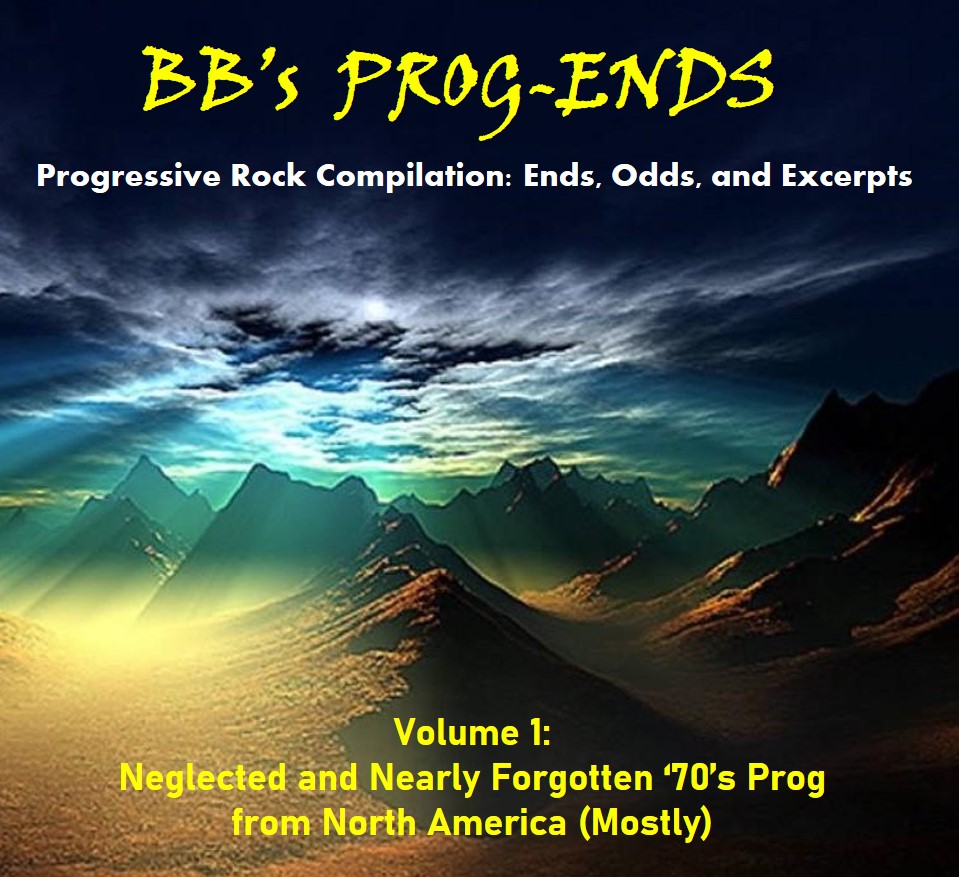
A Progressive Rock Compilation
Mp3 @ 320 kbps
OK, I’ve got something a bit different today. Rather than a post of unofficial live recordings, here’s an exclusive BB Chronicles Sampler Compilation album for you. A couple years ago when I did an extended feature on progressive rock, there was a whole lot of stuff I just wasn’t able to get to, as well as many bands that there just wasn’t any available unofficial content to post. So, this sampler goes back to that classic period of progressive rock in the ‘70’s and features some great tracks from some lesser-known, sadly neglected, or nearly forgotten progressive bands from that time, and, significantly, this particular compilation (possibly first in a series?) focuses primarily (with a couple exceptions) on bands from North America (U.S. and Canada) rather than the usual progressive emphasis on UK and Europe. For those interested in 70’s progressive rock, hopefully this sampler will introduce you to some different bands and music that you may not have been aware of and you can further check out on your own, or just to enjoy as a variety of different aspects of the progressive rock scene at that time. Just keep in mind that this compilation does not include any of the most popular and familiar prog bands, nor even any of the others that I have featured in previous posts, but focuses on these neglected, underrated, or somewhat passed over bands. Now, in order to keep this sampler to a manageable size (~CD-length, <80 min) and be able to feature numerous different bands, I edited down (excerpted) some of the longer tracks to give a decent representation of the music, but cut for time (sorry, but this is just a sampler). Now, I know that there are tracks on here that some will say “Hey, that’s NOT Prog!” because that’s just what they say to anything that doesn’t conform to their narrow definition. But rest assured, these are indeed all within the realm of progressive rock (or at least were at the time), as they do bring in various other influences and expand the boundaries of rock beyond the standard style and structure. So, Here goes, hope you enjoy it.
Prog-Ends 1
Tracklist: Artist – Song Title (Year – Album)
1. Ray Manzarek – He Can’t Come Today (1974 – The Golden Scarab: A Rhythm Myth)
2. Synergy – Relay Breakdown (1975 – Electronic Realizations for Rock Orchestra)
3. FM – One O’Clock Tomorrow (1977 – Black Noise)
4. Capability Brown – Circumstances (In Love, Past Present Future Meet) – excerpt (1973 – Voice)
5. Cathedral – Gong (1978 – Stained Glass Stories)
6. Happy The Man (1977 – Happy The Man)
7. Starcastle – Forces (1976 – Starcastle)
8. Harmonium – Vert (1975 – Si On Avait Besoin d'une Cinquième Saison)
9. Todd Rundgren’s Utopia – The Ikon – excerpt (1974 – Todd Rundgren’s Utopia)
10. Yezda Urfa – Boris and His 3 Verses, including Flow Guides Aren’t My Bag - excerpt (1975 – Boris)
11. Happy The Man – Service With A Smile (1978 – Crafty Hands)
12. Seventh Wave – Festival Suite (Festival-Ever So Lightly-Communication Skyways-Things To Come-1999-Dance of the Eloi) – excerpt (1974 – Things To Come)
Solidfiles link - ProgEnds1 Sampler Compilation.rar
Alternate link (Mega) - ProgEnds1_Sampler Compilation.rar
Notes:
I kick things off with
Ray Manzarek (former keyboards-composer,
The Doors). Now, Ray is certainly not someone you think of as progressive rock, but in 1974, after the demise of the Morrison-less
Doors, for his first solo album, Ray went all out and released a fantastic concept album, which builds upon the blues-rock basis of the music of
The Doors by exploring all kinds of riffs, rhythms, and musical styles from all over the world, as well as being steeped in various mystical and philosophical musings. Titled
The Golden Scarab: A Rhythm Myth, presented here is the opening track, ‘He Can’t Come Today’, a breezy, percussion-laden existential ditty featuring what is undoubtedly the ‘World’s Greatest Cowbell Solo’ from percussionist Steve Forman (starting at ~2:35). Absolutely stunning.
Next up is
Synergy, the creation of synthesizer wizard Larry Fast, with ‘Relay Breakdown’ from the first
Synergy album
Electronic Realizations for Rock Orchestra (1975), which was a pioneering all-synthesizer rock album. An innovative and progressive breakthrough in synthesizer technology, performance, and arrangement, it created a whole new soundscape for experimentation. Larry also worked with
Nektar, Peter Gabriel, Yes, and many others, but
Synergy (released 9 albums between 1975 and 1987) was his crowning achievement.
FM, a trio from Toronto, Canada, made a splash with their first album,
Black Noise (1977), an eclectic mix of melodic, electronic space-rock, featuring synths-vocals, violin, and drums, a great debut. Unfortunately, they could not sustain that level, and although they stuck around for several years (into the ‘80’s), their subsequent albums never quite matched their first (ranked among the Top 50 progressive Rock albums, at #49, by Rolling Stone magazine). Here is ‘One O’Clock Tomorrow’.
Capability Brown was a short-lived UK band (not from North America – oops, but they otherwise very much fit here) featuring strong multi-part harmony vocals and dynamic instrumental passages. Their first album (
From Scratch, 1972) was a straight-forward pop-rock album, but their second album (
Voice-1973) put them forever on the progressive rock map, mainly due to their epic 20 min, side-long masterpiece, ‘Circumstances’, which is excerpted here. For this compilation I have taken the opening section (to about 2:30), a Floyd-esque instrumental, but then cut to the final 6 minutes of the track, which features reprises of some of the previous sections, in order to give a sense of the feel of the song, but the full track is a masterful creation, and still stands today as a monumental Prog track. But not long after this album came out, the band was no more, and that was it.

Cathedral, from Long Island, NY, was another short-lived prog band (1975-1978) that never quite made it. Their one album, Stained Glass Stories (1978) was recorded and released by a small independent NY label and they were not able to go any further than that. But the album itself demonstrated their legit Prog props and chops, and slowly gained acclaim among the few who actually heard it. Eventually, renewed interest lead to a re-release by US progressive label Syn-Phonic in 1990, which eventually lead to a reunion in 2003. Presented here is ‘Gong’, a nice representation of the strength of the album.
Happy The Man, an excellent American (from Virginia, 1972-1979) prog band, blended lush melodies, complex interplay, a jazzy touch, and only occasional vocals, for a diverse, unique, and magical sound. Although they only released 2 albums before their demise,
Happy the Man (1977) and
Crafty Hands (1978), those albums are gems (and there were multiple subsequent album releases consisting of previously unreleased tracks, as well as earlier material from their pre-record label days). Included here are 2 shorter tracks, one from each of the first 2 albums, ‘Hidden Moods’ and ‘Service with a Smile’, each showing different sides of the band (Since their first song was a short one, had to give them another song to give them a fair representation here.
Starcastle, was an unlikely Midwestern progressive rock band from Champaign, IL that very much emulated the sound and style of
Yes, and thus was generally dismissed as being an unoriginal
Yes clone. Although this was understandable to some degree, as the band did quite often sound just like
Yes, particularly their Jon Anderson-like lead vocalist, it was also unfair, in that they were a very talented band that played all their own very good original songs (they never copied actual
Yes songs), but just played in a style similar to
Yes. And to me, that seems to be a very good thing, especially since these guys came along right around the time that
Yes themselves were losing their progressive luster (
Going For The One, Tormato, etc.), so I thoroughly welcomed and enjoyed their fresh take on the
Yes style. Plus, they had many other influences that also shaped their music. Their first album (
Starcastle – 1976) established their sound and reputation in this regard (and presented here is the track ‘Forces’), and they continued to grow and develop their own style over the next 2 albums (
Fountains of Light-1977,
Citadel-1978), but with limited commercial success, which lead them to move away from Prog towards more mainstream (and lackluster) rock for their next album, which was their last as it failed to generate much support.
Harmonium was a French Canadian progressive folk band from Montreal, Quebec that formed in 1972. They started out as a jazzy folk trio, but then delved into a more progressive form of folk music, utilizing a symphonic style and extended complex instrumental passages. They are best-known for their 2nd album (one of three they made),
Si on avait besoin d'une cinquième saison (If We Needed a Fifth Season), a concept album with each song representing a season, including a mythical fifth season. This is a beautiful, joyous progressive rock album, that has ranked among the Rolling Stone Top 50 (coming in at #36). Presented here is the opening track, ‘Vert’ (Spring).
Ok, so
Todd Rundgren doesn’t quite fit the ‘lesser-known’ categorization, but his foray into progressive rock with the original
Todd Rundgren’s Utopia does seem somewhat forgotten. Although later albums (by a completely different lineup) from the name-shortened
Utopia abandoned progressive rock for more mainstream pop-rock, the first
Todd Rundgren’s Utopia album (1974) was decidedly progressive, and here is an excerpt (the final 8 min) from the band’s LP-side-busting 30 min. epic track, ‘The Ikon’. This was the only studio album from this progressive version of the band (although an additional live album of mostly new material was released in 1975), which self-destructed in 1976, leading to many changes in personnel and musical direction.
Yezda Urfa was another Midwestern prog band (from Chicago, IL) that never made it. Formed in 1973 and influenced by
Yes, Gentle Giant, Focus, and
PFM, among others, they struggled to find an audience. They recorded a self-financed Demo album,
Boris, in 1975 that they shopped around to record labels, with no takers. They tried again in 1976 (self-financing again) and recording a more professional-sounding, elaborate album,
Sacred Baboon, but again, could not find a label willing to take them on, release, or distribute their already recorded album, and thus broke up without ever securing a record deal. However, years later, someone picked up a demo copy of
Boris at a used record store, got it into the hands of the progressive label Syn-Phonic, who managed to contact remnants of the band, and eventually released
Sacred Baboon in 1989, where it began to generate acclaim as a lost Prog masterpiece, resulting in
Boris also getting released, and eventually the band re-forming in 2004, and releasing a live album. Presented here is the original version of ‘Boris and his Three Verses, including Flow Guides are Not My Bag’ (which was revised and re-recorded for
Sacred Baboon, but I prefer this earlier version - although I shortened it just a bit for this sampler), which shows both the more melodic as well as rowdy cacophonous aspects of the band.
Next, second entry from Happy The Man, 'Service with A Smile', the cool instrumental opening track from Crafty Hands (1978).
Lastly, we have
Seventh Wave (who also is not from North America, UK again, but fits into the themes of this sampler), which was essentially two guys (multi-layered keyboards and drums) producing symphonic electronic progressive pop-rock, with catchy melodies, synth-heavy electronic soundscapes, and percussive oddities and flourishes galore. They only made 2 albums (as they reportedly never got along), the first being the excellent
Things to Come (1974) featuring a series of connected bright, bouncy, catchy electronic tunes. Presented here is the bulk of the concluding tracks from side 2 that I have banded together as the 'Festival Suite' (since it begins and ends with the same melodic theme). Again, some may consider this too ‘poppy’ to be progressive, but this ‘band’ is unique and unlike anything else, and to me this is what was especially great about progressive rock in the ‘70’s. A particular favorite of mine. Their subsequent album
Psi-Fi (1975) was disappointing in comparison, but still had many unique and interesting aspects.
So, there you have it. Hope this is of interest and many will enjoy it, as well as find some new (old) music and progressive bands worth checking out. Let me know what you think in the comments, and if you have some favorite lesser-known progressive-type bands that you’d like to share.
For more information on these and just about any other progressive rock-related band or album, The Prog Archives (www.progarchives.com) is a great resource, containing much info, reviews, ratings, etc. on all things Prog.